Predictive Maintenance Intelligence Transfer: Why Industrial AI Success Models Are Not Scaling to Workforce Analytics
Explore why the high-ROI predictive maintenance models used by industrial giants have failed to scale in workforce analytics and how to build the right data infrastructure to fix it.
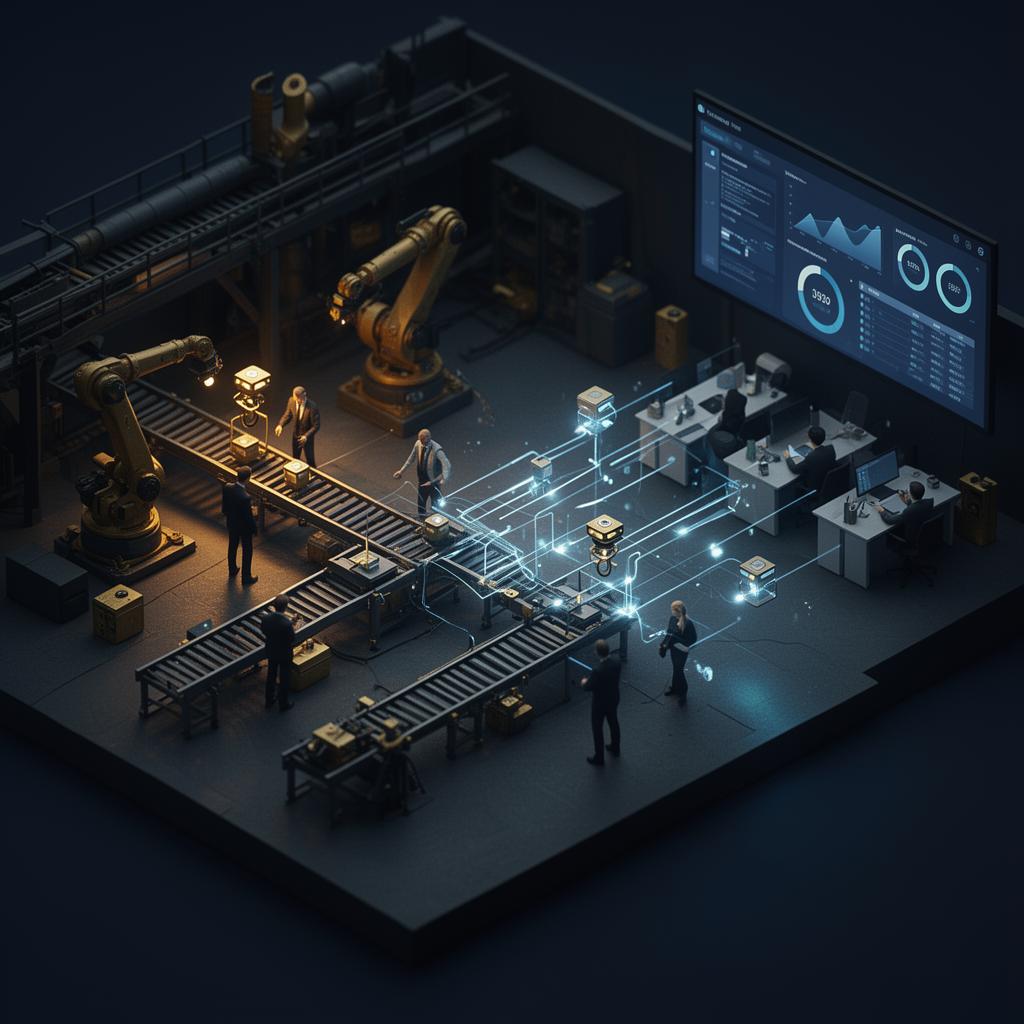
You have likely seen the headlines detailing how industrial giants manage their hardware. Rolls-Royce monitors thousands of jet engines in real-time, predicting a component failure before the pilot even notices a vibration. Siemens uses AI-driven industrial copilots to ensure that a manufacturing line never stops unexpectedly. The return on investment is clear, the systems are mature, and the results are measurable down to the last second of uptime.
In the world of physical assets, predictive maintenance is a solved problem. We have moved from fixing things when they break to preventing the break entirely. Yet, as you look at your workforce data, you see the exact opposite. People leave unexpectedly. Skill gaps emerge like sudden sinkholes. Performance dips go unnoticed until the quarterly review. The methodologies that revolutionized the factory floor are conspicuously absent from the Boardroom and the HR suite.
The failure to transfer these AI models from machines to people is not a lack of will. It is a fundamental misunderstanding of the data infrastructure required to power them. While industrial AI treats data as its oxygen, workforce analytics has historically treated data as a filing cabinet. To close this gap, you must rethink the very foundation of how you perceive human capital intelligence.
Industrial AI succeeds because it treats maintenance as a continuous stream rather than a series of disconnected snapshots.
The Signal Gap: Why Telemetry Does Not Equal Records
Imagine trying to predict a car engine failure by only looking at the vehicle registration and the annual smog check. You would have no idea how hard the engine is revving, the temperature of the oil, or the wear on the belts. This is exactly how most companies approach workforce data. They rely on "static" records: a hire date, a job title, and a yearly performance rating.
Predictive maintenance works because of telemetry. It relies on a high-frequency stream of data points that show how a system is behaving under pressure. In the workforce context, telemetry is not about invasive surveillance. It is about the "exhaust" of professional life: changes in reported skills, shifts in team structures, the velocity of promotions, and the historical movement of talent across an entire industry.
Most HR departments are stuck with "Lagging Indicators." By the time someone starts underperforming or puts in their notice, the "part" has already failed. To reach industrial-level maturity, you need "Leading Indicators" that function like heat sensors on an assembly line. This requires a shift from managing a contact database to building a live intelligence map.
Success in workforce AI requires moving from monthly snapshots to a continuous, historical flow of organizational behavior data.
Component Life Cycles versus Career Trajectories
In a factory, every part has a known life cycle. An engineer knows that a specific bearing will likely fail after 10,000 hours of operation. This creates a baseline for pattern recognition. In the workforce, we often assume that career paths are just as linear. We expect a software engineer to become a senior engineer in three years and a manager in five.
However, human assets are "plastic" in a way that steel and silicon are not. People gain new skills, they pivot to new industries, and their productivity is influenced by the "environment" of their peers. If you try to apply a rigid industrial model to a person, the model breaks because it cannot account for the volatility of human growth.
Industrial AI succeeds because it understands the "Interconnectedness" of the system. If one pump fails, it puts strain on the next. Workforce analytics often fails because it looks at the individual in a vacuum. You cannot predict the "maintenance" needs of an engineering team without looking at the external market pressure and the internal health of the leadership chain.
Workforce intelligence must model the entire ecosystem, accounting for how external market shifts put "stress" on your internal teams.
The Infrastructure Problem: Data Silos versus Data Lakes
If you visit a Siemens smart factory, the data is unified. The sensor on the floor talks to the supply chain software which talks to the maintenance schedule. It is a single, cohesive nervous system. In the corporate world, workforce data is tragically fragmented. Your recruitment data lives in one silo, your payroll in another, and your competitive intelligence in a third.
You cannot build predictive models on fragmented ground. Predictive maintenance requires "High-Fidelity History." To know what will happen tomorrow, the AI needs to see what happened over the last ten years across a thousand similar scenarios. Most companies only have a "Clean" history that goes back eighteen months, and even then, it is limited to their own four walls.
This is where the concept of workforce data as "Infrastructure" becomes critical. You wouldn't build a factory without a stable power grid and high-speed fiber. Yet, companies try to build advanced AI "Solutions" on top of broken, disconnected, and localized data sets. You need a historical, company-level data asset that spans the entire market to provide the necessary context for AI to function.
Predictive models are only as strong as the historical depth of the data infrastructure they sit upon.
The Problem of Preventive Intervention
In predictive maintenance, the "Prescription" is easy: change the oil, tighten the bolt, or replace the filter. In workforce analytics, even if an AI correctly predicts that a high-value team is at risk of "burnout" or "attrition," the intervention is complex. You cannot simply "replace a part" when dealing with specialized institutional knowledge.
The goal should not be to replace individuals, but to optimize the "System Health." This means using data to predict where the next major skill shortage will happen and beginning the "Preventive Maintenance" of upskilling three years before the shortage hits. It means identifying "Single Points of Failure" in your leadership structure before those leaders decide to leave for a competitor.
Workforce AI must evolve from simple attrition alerts to long-term structural health prescriptions.
Why the Transfer Failed: The Context Gap
Industrial AI models are trained on physics. Gravity, friction, and heat are constants. Workforce AI is trained on "Market Physics," which are constantly changing. A model built during a period of low interest rates and high growth will fail completely during a market contraction because the "Environmental Stressors" have changed.
To fix this, workforce analytics needs to incorporate "Environmental Data." Just as a jet engine monitor accounts for air density and altitude, your talent models must account for competitor hiring surges, regional economic shifts, and the historical "Flight Risk" profiles of specific roles across the entire industry. Without this external context, your internal data is just noise.
You cannot predict internal outcomes using only internal data: true predictive power comes from mapping your company against the historical backdrop of the entire market.
Building the Engine Room: A Forward-Looking Strategy
To replicate the success of the $107 billion predictive maintenance market within your own organization, you must stop viewing HR data as a support function. You must start viewing it as the "Engine Room" of your enterprise value. This requires a three-step shift in strategy:
- Move from Snapshots to Streams: Build or acquire data assets that show the historical evolution of companies and workforces over decades, not just months.
- Prioritize External Context: Stop looking in the mirror. Use large-scale, company-level intelligence to understand how your workforce compares to the broader market "Physics."
- Invest in Data Infrastructure: Focus less on the "Bells and Whistles" of AI interfaces and more on the foundational data quality that makes AI actually work.
The tools that kept the industrial revolution moving are finally ready to be applied to the human element of business. But they won't work if you keep feeding them scraps from a spreadsheet. They require a rich, deep, and historical data infrastructure that treats your workforce with the same analytical rigor as a billion-dollar turbine.
Your workforce is the most complex machine your company owns: it is time you started monitoring it with the same precision as a factory floor.
If you wouldn't run a jet engine without a real-time health monitor, why are you running a multi-billion dollar corporation on once-a-year surveys and static headcounts?