Rethinking the HR-Operations Chasm: Why Workforce Transformation Fails as an HR Problem
Learn why workforce transformation fails when treated as an HR-only problem and how to bridge the gap between talent analytics and operational intelligence.
Imagine your favorite airline suddenly experiences a 40 percent spike in flight cancellations. If the executive team treats this strictly as a human resources issue, they might offer pilots more flexible scheduling or launch a burnout awareness campaign. But if the actual problem is a broken fuel supply chain or outdated air traffic control software, those HR interventions will fail to move the needle. The planes remain grounded because the people strategy was disconnected from the operational reality.
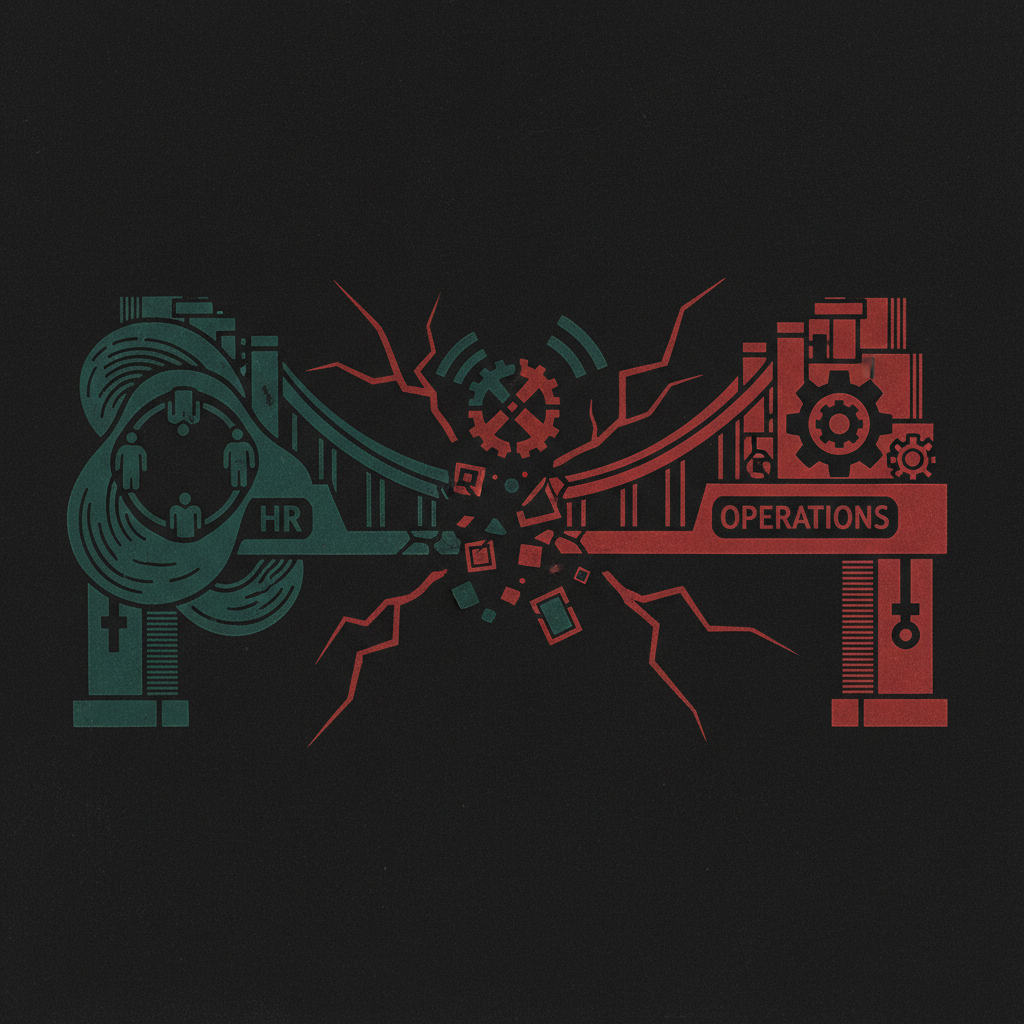
This illustrates the HR-Operations chasm. For too long, organizations have treated workforce transformation as a subset of HR technology. We buy expensive talent platforms and employee engagement tools while ignoring the structural pipes that dictate how work actually gets done. When the strategy fails, we blame the culture or the tools, when we should be looking at the data infrastructure between departments.
Workforce intelligence is not just about who people are or what they are paid. It is about how human capital interacts with operational capacity. In an era where AI is rapidly rewriting job descriptions and business processes, treating workforce data as a static HR silo is a recipe for institutional paralysis.
Workforce transformation fails because we treat it as a people problem instead of a process design problem.
The Healthcare Crisis: A Case Study in Misdiagnosis
The healthcare sector provides a sobering example of the HR-Operations divide. Hospitals across the country are facing record levels of nurse and physician burnout. The standard HR response has been to increase recruitment spend, offer sign-on bonuses, and implement wellness apps. These are classic HR interventions designed to fix a supply problem.
However, the data tells a different story. Burnout in healthcare is rarely a result of lack of resiliency. It is an operational failure. When you map workforce data against patient flow and administrative burden, you see that clinicians are spending upwards of 50 percent of their time on documentation and data entry. The work itself is designed poorly.
If you only look at HR data, you see high turnover. If you look at operational intelligence, you see a mismatch between human capability and process requirements. Solving the nursing shortage requires more than just hiring more nurses; it requires a radical redesign of the hospital floor, automated charting, and a reallocation of tasks that have nothing to do with patient care.
A people strategy that ignores operational friction is just an expensive way to maintain the status quo.
AI and the Trap of Premium Rehiring
We are currently seeing a chaotic trend in the corporate world: the rush to layoff and rehire. Companies are cutting thousands of roles in the name of AI efficiency, only to realize six months later that they have hollowed out their institutional memory. They are now rehiring for the same skill sets at a premium price because they lacked a unified view of their workforce infrastructure.
This happens because AI implementation is often treated as an IT project while headcount is treated as an HR expense. Without a data bridge between the two, leaders cannot see the hidden dependencies. You might automate a data entry task, but if that task was the primary way a junior analyst learned the nuances of your customer base, you have just destroyed your future talent pipeline.
Effective workforce strategy in the AI era requires unified visibility. You need to know not just how many people you have, but how their tasks weave into the operational workflow. When you see the workforce as infrastructure, you can forecast how a change in software will ripple through your organizational chart before you make the first cut.
Cutting headcount without understanding process context is like removing pillars from a building because you want more floor space; eventually, the ceiling collapses.
Moving Beyond the Static Contact Database
Most HR systems are glorified contact databases. they tell you a name, a title, a salary, and a location. This is static data. It is useful for payroll, but it is useless for strategic decision-making. Operational intelligence requires dynamic, historical data that captures the evolution of roles and the movement of talent across the entire market.
You need to see the workforce as a fluid asset. How are your competitors restructuring their engineering teams? Where is the talent migrating after a major industry merger? Bringing this level of external visibility into your internal operational planning is what separates leaders from followers.
Think of it like a GPS for your company. A contact database is a paper map from 1995. Workforce intelligence is a real-time navigation system that accounts for traffic, road closures, and changing terrain. You cannot drive a modern enterprise with an outdated map and expect to reach your destination on time.
Scalable workforce data must be treated as core business infrastructure rather than a peripheral HR reporting requirement.
Bridging the Chasm with Unified Intelligence
To bridge the gap between HR and Operations, organizations must shift their perspective. The Workforce Intelligence lead should be deep in the room during operational planning sessions. They should be asking: If we change this supply chain process, what skills will we need in eighteen months? If we automate this service line, where can we redeploy that human capital to drive the most value?
This requires a high-fidelity data asset that speaks the language of both the CEO and the CHRO. It means moving away from monthly snapshots and toward a continuous, historical view of the workforce landscape. This data must inform operational redesign, while operational metrics must feed back into the people strategy to create a virtuous loop.
When you align these two worlds, you stop reacting to crises and start anticipating them. You build an organization that is not just efficient, but resilient. You create a workforce that is integrated into the very fabric of your business operations rather than being a cost center managed by a separate department.
Three Steps to Operationalize Your People Data
- Integrate talent analytics directly into business process reviews, not just annual performance cycles.
- Map external talent migration patterns against internal operational needs to identify future skill gaps.
- Treat workforce transitions as architectural changes, requiring a blueprint of how work actually flows through the enterprise.
The most successful companies of the next decade won't have the best HR tech; they will have the best workforce-to-operations integration.
Closing the Loop
The chasm between HR and Operations is the single greatest threat to institutional agility in the modern economy. We can no longer afford to treat the people who do the work as separate from the work itself. Whether you are navigating the burnout crisis in healthcare or the AI revolution in finance, the solution is the same: unified intelligence.
Vivameda provides the historical, large-scale workforce data assets that make this unification possible. We help you see the ground truth of the labor market so you can build a more robust operational future. The era of siloed HR is over. The era of workforce infrastructure has begun.
The question is no longer how many people you need; the question is whether you actually understand what your people are doing well enough to survive the next shift in the market. If you continue to treat your workforce as a line item rather than an engine, do not be surprised when the machine stops running.